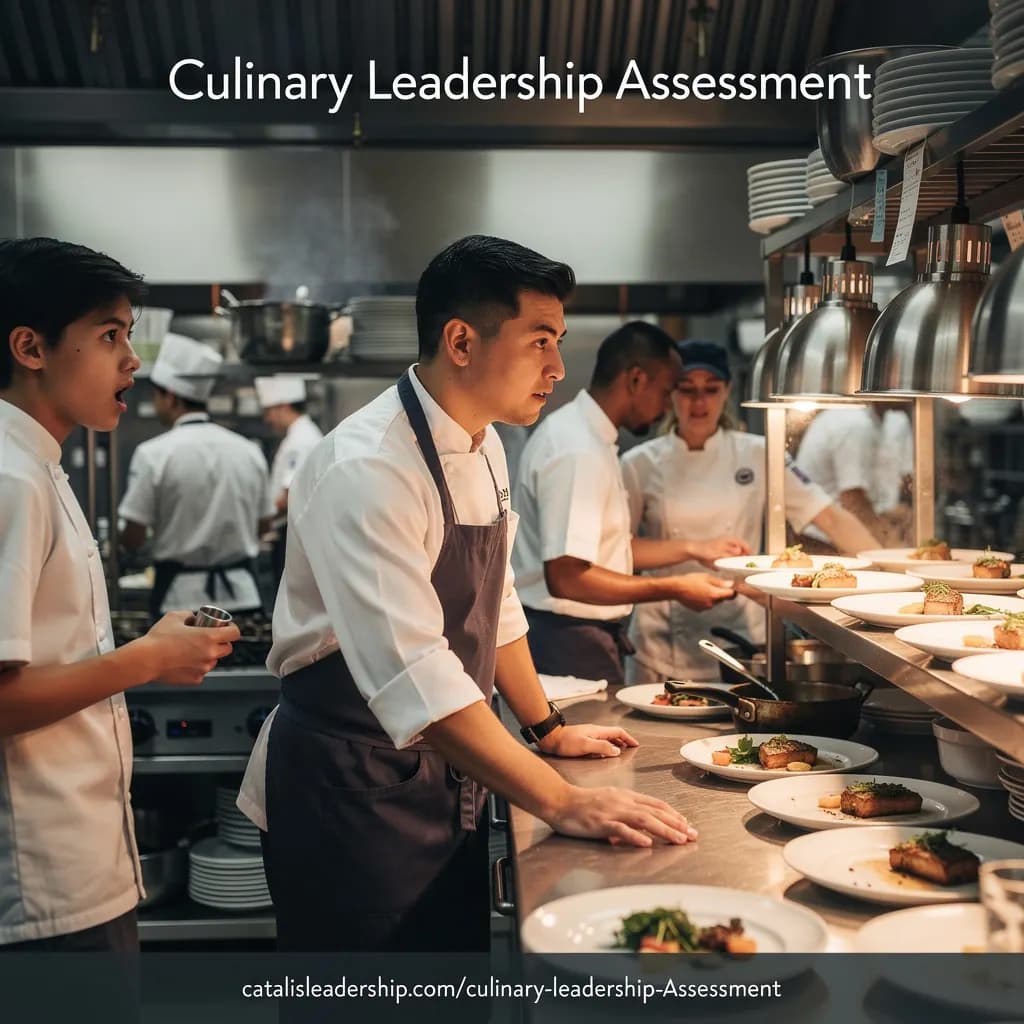
There's a moment most culinary leaders know.
The ticket rail is full. Someone called out. The prep list didn't get finished. A new hire is in the weeds and starting to panic. The table in the corner has been waiting too long and the expediter is about to lose it.
In that moment, technical skill matters — but it's not what gets you through. What gets you through is something harder to name and a lot harder to measure: the ability to stay regulated when everything is loud, to read the room, to make a call with incomplete information, to bring people with you instead of just barking orders and hoping.
That's leadership. And almost no one in this industry is measuring it.
What We've Been Using Instead
When culinary programs and workforce organizations want to assess their participants, they reach for what's available. Usually that means one of two things.
The first category is personality assessments. DiSC. Myers-Briggs. CliftonStrengths. These are legitimate instruments with real research behind them. But they measure personality style — who you are, not what you can develop. That's not a criticism, it's just what they're built to do. A DiSC profile doesn't tell you whether someone can hold a team together under pressure. It tells you how they're wired. And wiring doesn't change much.
The second category is technical credentials. ACF certifications. ServSuccess. Food safety. These matter enormously — we're not dismissing them. But a credential tells you what someone can demonstrate in a controlled environment. It doesn't tell you how they handle conflict, whether they listen when it counts, or whether they can make a good decision when they're tired and the information is incomplete.
There's a gap between those two categories. It's been there a long time. And it's exactly where leadership actually lives.
What the CLA Measures
The Culinary Leadership Assessment was built to fill that gap. It measures five interpersonal leadership skills — not personality traits, not technical competencies, but developable skills that research consistently links to team performance, retention, and leadership effectiveness.
Resilience & Adaptability. This isn't just staying calm. It's the capacity to absorb disruption, recalibrate, and keep moving — and to help the people around you do the same. In culinary environments, this skill gets tested constantly. The question isn't whether you'll face pressure. It's how you respond when you do.
Communication & Active Listening. Both halves matter, and they're not the same thing. Many people who communicate clearly are poor listeners. Many attentive listeners struggle to convey information with precision. The CLA measures both — how well you transmit and how well you receive. In a kitchen or service environment, gaps in either direction create real problems.
Problem Solving & Decision Making. Real-world problem solving happens under time pressure with incomplete information. The CLA doesn't test textbook logic. It presents situational scenarios and measures how participants identify the actual issue, weigh their options, and commit to a path forward — including when there's no perfect answer.
Teamwork & Collaboration. This goes beyond "works well with others." It measures how participants function inside a group: whether they contribute when it's inconvenient, navigate conflict productively, support peers without being asked, and keep their eye on shared goals rather than individual performance.
Emotional Intelligence. This one tends to predict everything else. The CLA measures all four dimensions — self-awareness, self-regulation, social awareness, and relationship management. Participants who score well here typically show up differently across every other skill area. Participants who score low here often struggle in ways they can't fully see or explain.
How It Works
The CLA uses situational judgment questions. Not personality surveys, not abstract ratings, not "on a scale of one to five, how good are you at listening." Real scenarios. Situations that mirror the kind of decisions culinary professionals face every day. Participants read the scenario and choose how they'd respond — and those choices reveal patterns that a self-report survey never could.
The result is a personalized report that places each participant across all five skill areas and gives them concrete language for where they are and what to work on. It's not a label. It's not a type. It's a mirror — one that reflects something specific and actionable.
The assessment takes about ten minutes. It's free for individuals. And it was built specifically for culinary and hospitality professionals — not adapted from a corporate HR tool, not generic enough to apply to every industry equally.
Why This Matters Now
Culinary workforce development has made enormous strides. Programs across the country are doing serious work — not just teaching knife skills and mise en place, but preparing people for careers, for leadership, for lives that are different from what they started with.
But the tools we use to understand participants haven't kept up. We know how to measure technical readiness. We don't have great tools for measuring leadership readiness. That gap costs programs. It costs participants. It costs employers who hire people into leadership roles without a clear sense of what they're actually working with.
The CLA is an attempt to close that gap — to give culinary workforce organizations a way to see their participants more completely, and to give individuals a way to see themselves more honestly.
If you work in culinary or hospitality and want to know where you stand, take the assessment. It's free, it's honest, and it was built for this industry.
→ catalisleadership.com/culinary-leadership-assessment
If you lead a culinary program or workforce cohort and want to explore using the CLA with your participants, reach out. We'd love to talk about what that could look like.