What is emotional intelligence?
Emotional intelligence is the ability to recognize and regulate your own emotions so you speak and act in ways that move your goals forward. It is also recognizing other people's emotions, seeing how your words and actions affect them, and choosing responses that build relationships and shared success. Steve Weiss of Catalis Leadership sees it as the foundation of leadership.
Published
What are the four parts of emotional intelligence?
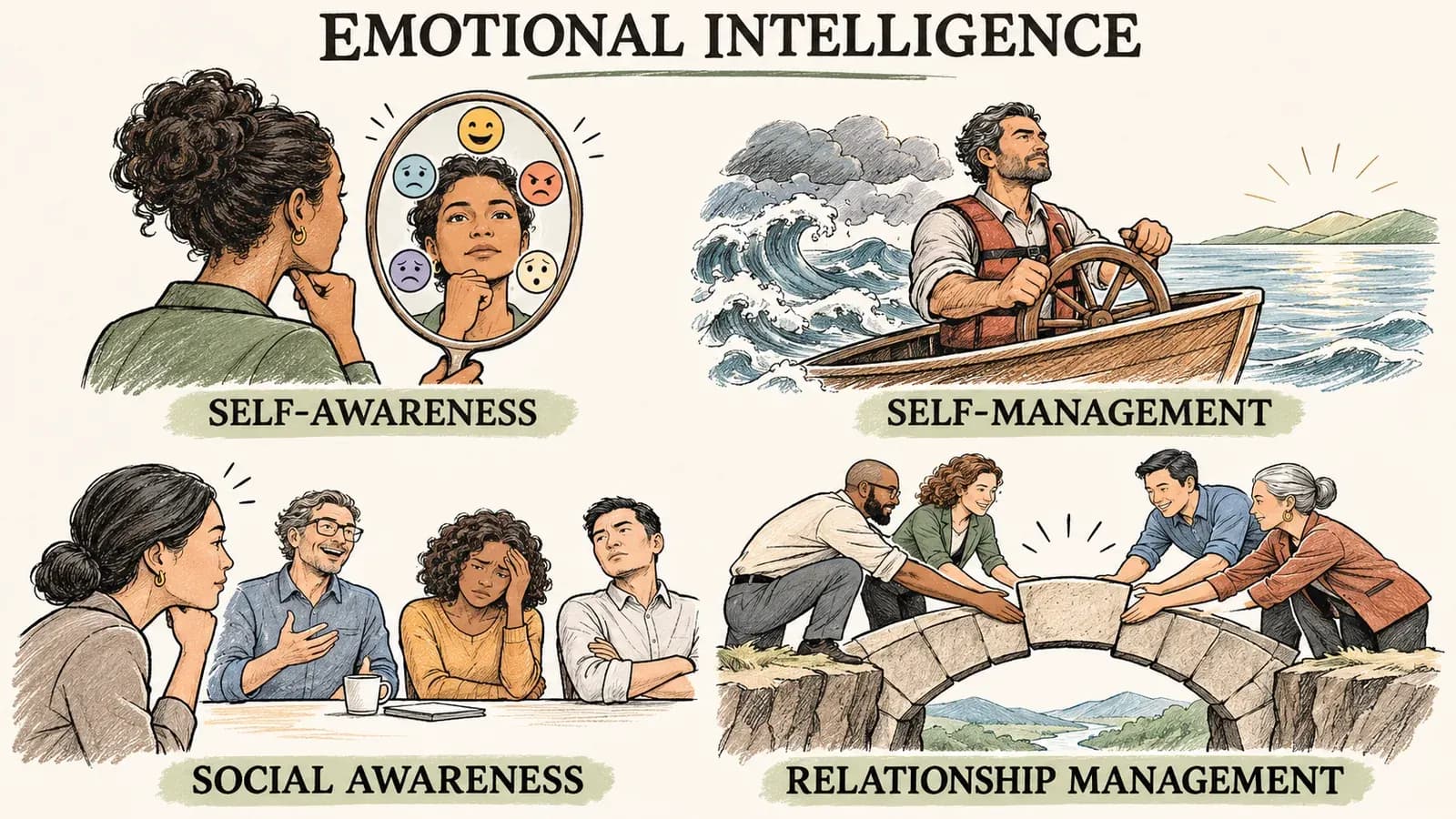
Psychologist Daniel Goleman described emotional intelligence in four parts. Two face inward and two face outward. They work as a chain. You can't skip a link.
INWARD
- Self-awareness: Name it precisely.
- Self-management: Buy the two seconds.
A hijacked brain can't read the room.
OUTWARD
- Social awareness: Read what they're carrying.
- Relationship management: Choose the response that builds the relationship and moves the work forward.
The first two unlock the other two. A leader who is caught in the moment can't read anyone else in it.
What happens when the alarm goes off?
Under pressure, the brain's alarm system fires faster than thought. It floods the body and takes the thinking brain offline. Goleman called it an amygdala hijack. Most leaders just call it losing their cool. In that moment, reflex is driving. The judgment, values, and creativity that make someone a good leader are briefly out of reach.
How the hijack shows up in leaders
| Response | What it looks like in a leader |
|---|---|
| Fight | Pushing back hard, raising your voice, winning the point |
| Flight | Avoiding the conversation, ending the meeting early |
| Freeze | Going blank when the question lands |
| Fawn | Agreeing just to make the tension stop |
Fight
What it looks like in a leader
Flight
What it looks like in a leader
Freeze
What it looks like in a leader
Fawn
What it looks like in a leader
None of them is a decision. All four are the body trying to protect itself.
How do you get the thinking brain back?
You can't out-muscle the alarm. You can name it. Brain-imaging research on affect labeling shows that putting a feeling into words calms the brain's alarm center and brings the thinking brain back online. The more precise the word, the more it helps. "Frustrated" gives you little to work with. "Dismissed" tells you exactly what to address.
- The vague word: frustrated. ALARM is down and WISE BRAIN is up, balanced on the word. The alarm keeps the weight.
- The truer word: dismissed. WISE BRAIN is down and ALARM is up, balanced on the word. The thinking brain takes the weight back. You get a choice.
- Name it: the truer word, to yourself
- Breathe: one breath is the gate
- Choose: the move that represents you
An emotion wheel helps. You start with the big feeling in the center and work outward to the truer word.
Where does resilience fit?
Resilience isn't never getting knocked off balance. It's how quickly you get your footing back, and how steady you stay for the people who depend on you. It lives in self-management. Every time a leader names the feeling, breathes, and chooses, the recovery gets faster. Teams notice. A leader who resets steadies the room. A leader who stays hijacked spreads it.
How do leaders read the people around them?
Nobody walks in wearing their emotion as a name tag. What you get is evidence.
The four signals
| Signal | What to watch |
|---|---|
| Face | The fastest signal, and the easiest to control. Never read it alone. |
| Body | Posture and pace. Moving slower, or suddenly faster. |
| Voice | Not the words. The delivery. Short answers from someone who usually talks. |
| Change | The most telling signal: different from that person's normal. |
Face
What to watch
Body
What to watch
Voice
What to watch
Change
What to watch
One signal is a hunch. Two pointing the same way is a read. Positive states count too. Spotting pride or relief in someone matters as much as spotting frustration.
What do you do with a read?
A read is a guess until you check it. Quiet and short answers can mean worry, exhaustion, anger, or simple focus. So there are three steps. Most leaders skip the middle one.
Read
You notice the signals and land on a word, loosely.
Check
You name what you saw, then ask. "You've been quiet in the last two meetings. How are things going?" works. "Why are you upset?" puts them on the defensive.
Move
You match your response to what is actually going on: give space, lighten the load, listen deeper, say the good thing out loud, or change your delivery. Your tone carries the move. You can't send calm you don't have, which is why the first two links come first.
Does emotional intelligence affect career success?
Yes. When Daniel Goleman analyzed what set outstanding performers apart, he found emotional intelligence was twice as important as technical skill and IQ at every level, and more important the higher people rose. A 2011 review of the research by Ernest O'Boyle and colleagues found that emotional intelligence predicts job performance even after accounting for intelligence and personality. It shows up in pay too. A 2015 study led by Tassilo Momm found that people who read others' emotions accurately earned more each year, even after accounting for education, hours worked, and position. They earned more because they handled the people side of work better.
This matters most at the top. By the time someone reaches the executive level, intelligence and technical skill are a given. Everyone there has them, so they no longer set leaders apart. Emotional intelligence does. A senior leader's emotions also travel further. In Primal Leadership, Goleman, Boyatzis, and McKee describe a leader's mood as contagious: it spreads through the team, and through every team below. And the higher a leader rises, the fewer people tell them the truth about their impact. The authors call it "CEO disease." Leaders with strong emotional intelligence notice their effect anyway.
Can emotional intelligence be developed?
Yes. This is the conviction at the center of my coaching, and the research backs it. Daniel Goleman, who brought emotional intelligence into the business world, wrote that it can clearly be learned. It grows with maturity, but many leaders still need focused development, and he warned that a short seminar won't do it. Richard Boyatzis of Case Western Reserve University followed graduate students and executives for more than 20 years. Their emotional intelligence grew, and the gains held as long as seven years later. A 2019 review of 58 studies by Victoria Mattingly and Kurt Kraiger found the same: emotional intelligence training produces real gains. The programs that worked best included practice and feedback. Emotional intelligence and resilience are the foundation every other leadership skill stands on. Both can be coached.
This page, on one page
Two pages: the four parts of emotional intelligence as a chain, and the Emotion Wheel for finding the truer word.
Questions
What are the four parts of emotional intelligence?
Self-awareness, self-management, social awareness, and relationship management, as described by Daniel Goleman. The first two face inward. The other two face outward.
What is an amygdala hijack?
It is the moment the brain's alarm system takes over under stress, before the thinking brain can respond. Goleman coined the term.
Can emotional intelligence be learned?
Yes. A 2019 review of 58 studies found that training produces real gains in emotional intelligence, especially when it includes practice and feedback. Like any skill, it grows with work.
How is resilience related to emotional intelligence?
Resilience is largely self-management in action: how quickly you recover your footing after a hard moment, and how steady you stay for others.
Why does emotional intelligence matter for leaders?
Because a leader's words and actions shape how their people feel, and how people feel shapes what they do. Leaders who regulate their own emotions stay focused on their goals. Leaders who notice their effect on others can choose the words and actions that build relationships and move the work forward.
Sources
Emotional Intelligence
Daniel Goleman, 1995
- What Makes a Leader? (opens in a new tab)
Daniel Goleman, Harvard Business Review, 1998
hbr.org
Primal Leadership
Daniel Goleman, Richard Boyatzis, and Annie McKee, 2002
- Putting Feelings Into Words (opens in a new tab)
Matthew Lieberman and colleagues, Psychological Science, 2007
doi.org
- A 20-year view of trying to develop emotional, social and cognitive intelligence competencies in graduate management education (opens in a new tab)
Richard Boyatzis and Argun Saatcioglu, Journal of Management Development, 2008
doi.org
- The relation between emotional intelligence and job performance: A meta-analysis (opens in a new tab)
Ernest O'Boyle and colleagues, Journal of Organizational Behavior, 2011
doi.org
- It pays to have an eye for emotions: Emotion recognition ability indirectly predicts annual income (opens in a new tab)
Tassilo Momm and colleagues, Journal of Organizational Behavior, 2015
doi.org
- Can emotional intelligence be trained? A meta-analytical investigation (opens in a new tab)
Victoria Mattingly and Kurt Kraiger, Human Resource Management Review, 2019
doi.org
Leadership/Impact® is a registered trademark of Human Synergistics International.
Related pages
- Executive Coaching
One-to-one coaching built around your vision and goals.
- Leadership Impact Coaching
A coaching program built around two Leadership/Impact® assessments, so you see the change.
- How Your Leadership Style Drives Your Team's Behavior
A leader's style sets the behavior a team believes is expected. How that happens, what it looks like, and how to measure and change it.
- Burning Platform to Burning Ambition
Why fear starts a change and wanting something keeps it going.
- Culinary Leadership Assessment
A free 15-minute assessment for culinary leaders that includes emotional intelligence and resilience.

A Conversation About Leading From Steady Ground
Cleveland· Coaching available nationwide and worldwide
If you want to grow your emotional intelligence and resilience, and the effect they have on the people around you, I would welcome a conversation.
Free 30-min call · No obligation · Response within 24 hours