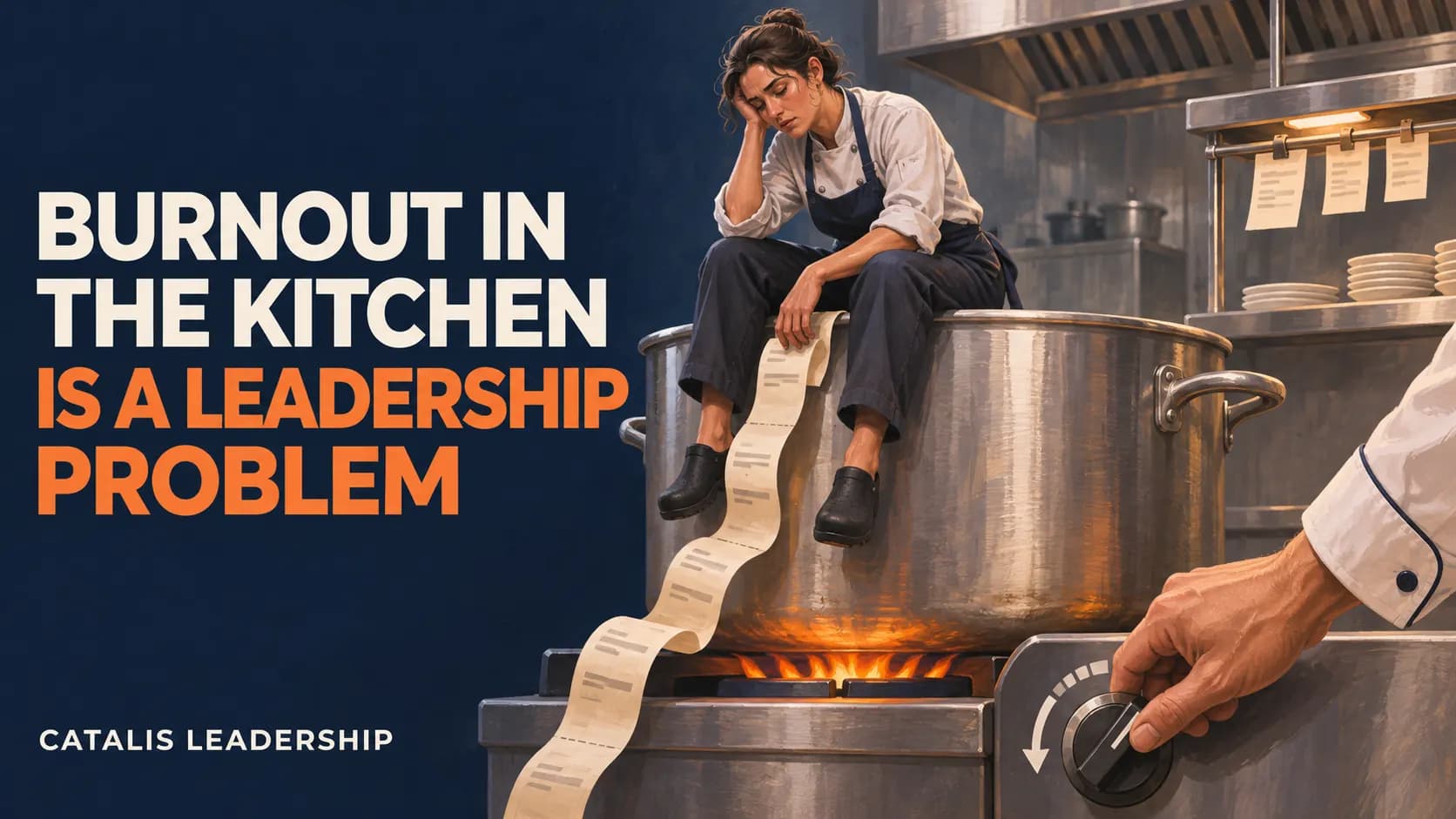
Burnout is the leading reason hospitality professionals leave their jobs, according to the 2026 Culinary Agents Talent Insights Report. Kitchens have long treated it as part of the job, or as a sign that someone could not handle the heat. The research points somewhere else. Burnout is driven mostly by how people are managed. That means leaders at every level have more control over it than they think, from the lead cook running a station to the CEO running a company. One two-Michelin-star chef proved it by closing his restaurant three days a week.
A Two-Star Kitchen That Closed Three Days a Week
In 2015, chef Sat Bains and his wife and business partner, Amanda, made a decision that surprised the restaurant world. Their two-Michelin-star restaurant in Nottingham, England, would open only four days a week. Staff salaries and bonuses would stay the same.
Bains expected the change to cost the business more than £100,000. He made it anyway, because keeping good chefs had become too hard. After the announcement, the restaurant received more than 60 applications from chefs. Years later, Bains called the move transformational. His team became more stable, working about 45 hours condensed into four days. As he put it, "It made us all a bit busier, but it also made everyone work more efficiently."
Bains did not give his cooks a wellness seminar or tell them to toughen up. He changed how the work was organized. Most leaders cannot close their business three days a week. Every leader can change something about how the work is organized.
What Burnout Actually Is
The World Health Organization classifies burnout as an occupational phenomenon, not a medical condition. Its definition ties burnout to chronic workplace stress "that has not been successfully managed." It names three signs:
- Exhaustion
- Mental distance from the job, or cynicism about it
- A drop in how effective people feel at their work
The key word is managed. Hard work by itself does not cause burnout. Stress that nobody deals with does.
In a kitchen, those signs are easy to miss because they look like attitude. The cook who used to stay late to perfect a sauce now does the minimum and leaves. The server who joked with regulars has gone quiet. A bad attitude did not appear out of nowhere. Those are the second and third signs.
The Numbers in Our Industry
The 2026 Culinary Agents report surveyed 2,637 hospitality professionals across front and back of house. Burnout was the top reason they leave an employer. Career growth was the top reason they choose one.
A January 2026 global survey of 460 chefs, by Bournemouth University and The Burnt Chef Project, found that 69 percent often or always think about leaving their current role. Nearly 70 percent said work interferes with their home and family life. Chefs described fear-based management. They also described toxic behavior being tolerated from people seen as high performers. The researchers traced a cycle that every operator knows: understaffing leads to longer shifts, longer shifts lead to burnout, burnout leads to resignations, and resignations lead to more understaffing.
Outside the kitchen the pattern holds. In a 2018 Gallup study of nearly 7,500 full-time employees, 23 percent said they felt burned out very often or always, and another 44 percent sometimes. Burned-out employees were 2.6 times as likely to be actively looking for a new job.
Five Causes, All Within a Leader's Reach
Gallup identified the five factors most strongly linked to burnout. Gallup's conclusion was that burnout has less to do with expectations of hard work and more to do with how people are managed.
- Unfair treatment. The favorite who always gets the best shifts. The talented cook whose temper everyone works around.
- Unmanageable workload. Running a station built for two with one person, week after week.
- Lack of role clarity. Nobody is sure who checks the walk-in, who places the order, or who closes.
- Lack of communication and support from the manager. The chef who only speaks up when something goes wrong.
- Unreasonable time pressure. Service is time pressure by design, and good cooks love that. The unreasonable part is cutting prep hours to save labor, so the rush starts before the cook walks in the door.
Swap the details and the list fits any office. Picture the team that always gets the plum projects, or the deadline set without asking the people who have to meet it.
What Any Leader Can Do This Week
- Check fairness first. Look at last month's schedule. Who got the doubles, the closing shifts, the holidays? If it is the same few people, fix that before anything else.
- Staff for the real workload. If you cannot add people, take something away: a menu item, a prep task, a report nobody reads.
- Make roles plain. Write down who owns what. Ambiguity creates work that falls on whoever cares most, and those are the people you can least afford to lose.
- Talk to people when things go right. A two-minute check-in at the end of a shift, when nothing is wrong, builds the trust that lets people tell you when something is.
- Stop protecting the high performer who mistreats others. Every time you excuse it, the team learns whose wellbeing counts.
- Watch for the shift from engaged to distant. It is the earliest warning sign you will get. Ask about it privately.
If You Don't Have a Title
You do not need to run the kitchen to make a difference here.
- Know your own early signs. For some people it is short sleep. For others it is snapping at a teammate over nothing.
- Speak up early and be specific. "I've worked six doubles in two weeks and I'm starting to make mistakes" gives a leader something to act on. "I'm tired" does not.
- Share the load fairly. When you cover for someone, cover for everyone, not just your friends.
- Protect your recovery. Eat during the shift. Make your days off actually off.
- Notice the teammate who has gone quiet. One honest question at the right moment can matter more than you know.
Where Resilience Fits
I believe emotional intelligence and resilience are the foundational skills of leadership, and that both can be learned. Emotional intelligence is how a leader notices the signs before someone quits. Resilience helps a person recover from a brutal night and come back steady. But resilience cannot make up for a system that wears people down. Asking a burned-out cook to be more resilient, without changing the schedule or the staffing, only moves the problem.
Sat Bains could not change the whole industry. He changed his own kitchen. Every leader, at every level, controls some part of how the work gets done. Start with the part you control.
Sources
- Culinary Agents, "Positive Leadership: What the 2026 Talent Survey Means for Employers"
https://culinaryagents.com/resources/positive-leadership-what-the-2026-talent-survey-means-for-employers - Hospitality Net, "Why Chefs Leave? What a Global Survey Reveals About the Kitchen Retention Crisis" (Bournemouth University and The Burnt Chef Project, January 2026)
https://www.hospitalitynet.org/opinion/4130720.html - Gallup, "Employee Burnout, Part 1: The 5 Main Causes"
https://www.gallup.com/workplace/237059/employee-burnout-part-main-causes.aspx - World Health Organization, "Burn-out an 'occupational phenomenon': International Classification of Diseases"
https://www.who.int/news-room/detail/28-05-2019-burn-out-an-occupational-phenomenon-international-classification-of-diseases - The Caterer, "Hospitality four-day week" (Sat Bains interview)
https://www.thecaterer.com/indepth/hospitality-four-day-week - Restaurant Online, "Sat Bains: Restaurant set for six-figure hit due to four-day working week"
https://www.restaurantonline.co.uk/Article/2015/10/12/Sat-Bains-four-day-week - Fast Casual, "Understaffing top stressor for restaurant workers, study finds" (7shifts 2026 report)
https://www.fastcasual.com/news/understaffing-top-stressor-for-restaurant-workers-study-finds/